

Today’s accompanying tune: “Lighthouse” by Noah Kahan
From the road, the forest looked healthy. As the van sped through the winding, gray roads of Washington’s Olympic peninsula, the trees on both sides blurred together into a mass of heavy, dense green and deeply furrowed red-brown bark. It was January, the rainiest month of the year in one of the rainiest parts of the country, and ours was among a small handful of vehicles making the familiar summertime trek between the city to our East and the wild rainforest reaching toward the Pacific Ocean, the one covered in neon green moss and ancient ferns that reached far above my head. Indicator species, they’re often called. Species that indicate the health of the forest, the lack of disturbance or disruption required to build a slow-growing home among the gnarled branches and sheltered floor of an old growth cathedral.
But along the road, in a forest that seemed healthy, the moss and ferns told a different story. Or, their absence did. Though the dense stands of trees lined the highway, they were without their indicator species, without furry green sleeves around their branches or leafy coverage huddled at the base of their trunks. They were alone, exposed, a hegemony meant to retain the feel of a healthy forest, even as they disguised the tragedy just beyond.
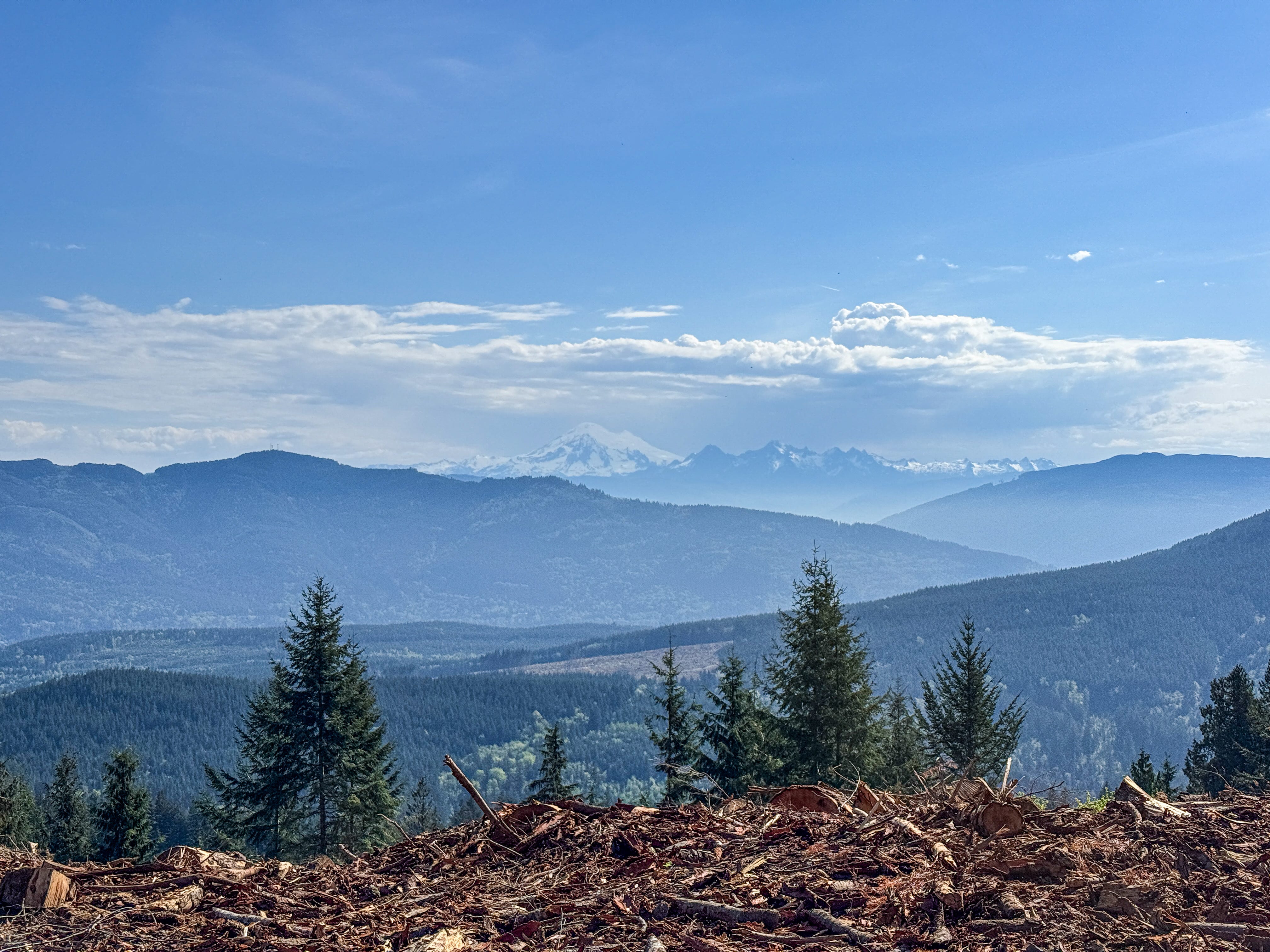
Each time our car slowed, the illusion of a healthy forest faded. The trees unknotted themselves as the wheels rolled to a halt, revealing the trick as each individual tree stood apart, alone, maybe two or three rows deep along the asphalt. In the gaps between the trees, the sharp innards of their peers littered the ground, smothering the ferns that hadn’t been trampled by heavy machinery intent of bringing this forest to its knees. The newly exposed line of trees — the fencing meant to obscure the ugliness that lay beyond — became too hot, too hostile. The moss shrank away, and the ferns withered in the abundant sunshine. Upon closer inspection, the truth was clear: this was not a healthy forest, and hadn’t been for quite some time.
Timber is Washington’s biggest export; forests across the state may easily be second, third, or fourth generation, so heavily have they been cut and harvested. The diversity and strength of old growth is typically replaced by fast-growing monoculture forests of Douglas fir or alder, trees that can be harvested again in a few decades instead of the several centuries other trees require to reach full maturity. To logging companies, the forest presents only a simple equation, one that puts growth of profits above growth of ecosystem. It is not in their best interests to cultivate a thriving, healthy forest. Every year these companies don’t harvest is a year in which they don’t make any money, a cost sunk into the depths of the detritus their last extraction left upon the landscape. The monoculture forests planted in the aftermath of a clearcut are unusually susceptible to fires, to pests, to plagues. To withering away in years of drought and heat, to toppling over in windstorms each winter or sliding down the hillside when the rain does arrive, their roots unable to sink to the depths required to stabilize the earth around them. The trees are planted too close together to thrive but close enough to make the harvest a fraction more efficient. The forest, a resource from which profits are the biggest extraction.
The claims of sustainability and fire suppression fail to bear the weight given to them by the companies; if they did, the fence of of trees left to attempt to conceal their work wouldn’t remain standing, their existence a testament to the hideousness of the work, of the results, of the affect on the environment in which it occurs. As with the absence of moss and ferns, it is simply the existence of the illusion that belies its false pretenses. It is not for the good of the world, for the good of the forest, that trees are slashed and carted off to factories in the bed of semi trucks. It is a solution to a problem these companies create; healthy, mature forests are the best defense against pests, fires, drought. As with humans, monoculture breeds risk, breeds weakness. It is an unsustainable balance with fingers holding both sides of the scale.
The illusion can only hold so long.
The scars along the hillsides are visible, unobscured by a tactical retention of roadside trees. Their harsh edges expose the trees, planted too close together many decades earlier so that their understories are thinned while their canopies reach towards the clouds, giving the appearance of a fir that forgot to don its pants and is at risk of toppling over due to its imbalance. They will be harvested, too, eventually. Slashed. Pinched. Sawed. Cracked. Stripped. Hewn. Burnt. They will not have the life of a tree, one marked by bark beetles and drought. They will become homes, shelves, fences, their days exposed along the hillside lost only to the memory of the motorists speeding below, the ones who looked up and mourned the loss laid in place decades before they were born. The chessboard of the mountains will remain, the new growth stunted uniformly, perpetually attempting to catch up to those around them, those that will be removed and leave them exposed all the same.
Up close, the violence of a clearcut is extremely clear. Shards of fallen trees litter the ground, the glowing white interior of an otherwise healthy tree shining harsh in the equally jarring light. The branches stick up from the ground in unnatural angles, a menacing threat towards the sky, towards the soft underbellies and feet of the creatures that formerly found respite, found home, under their shade. There is no profit in a clean operation, nor is there any in one with carefully considered strategy. The forest, its inhabitants, its advocates, all left to burn in the harsh reality of a world without the protection of the forest.
The Trump Administration has made clear its intent to sell Washington’s forests — and forests across the West — for its parts. A series of declarations of emergency without catalyst and reductions of enforcement have nodded to the companies eyeing the forest and licking their lips in anticipation, the green reflecting in their eyes that of banks and not of nature. The Forest Service has been clearcut in its own way, with experts, scientists, arborists, and naturalists removed to make room for quick-growing, opportunistic professionals more concerned with the growth of profit than the health of the forest they’ve been ostensibly sworn to protect. To Administration officials, resources are to be extracted, exploited, profited from. They are not to be protected, nurtured, or maintained.
The ecosystems dependent on them will fall, too, another victim of an administration focused only on violence and exclusivity. Denizens of the forest — bears, mountain lions, deer, elk, moose, bobcats — will be forcibly removed and seek refuge in increasingly dangerous territory marked by vehicles and trash bins. Soils will degrade, and landslides will continue to close interstates on which humans depend. Water will be polluted, salmon will be unable to spawn. Snow will melt too soon, and air quality will plummet. Where goes the forest, so go we all.
Forests lifespans far outstretch our own, making recovery visible in our short lifetimes hard to imagine but not one that has crossed into the realm of the impossible. It is an act of optimism, to advocate for a better world we will never inhabit. It is not radical, nor is it delusion. It is the only option we have, to restore the ecosystem as it has been, to undo the violence and the damage committed in our name, so that those after us will not be subject to the illusions we’ve conjured for ourselves.
In the forests we create, they will listen as the dense canopies dampen the noise. They will marvel at the moss so saturated it is if they are lit from within. They will walk through ferns that reach far above their heads, covering the bases of trees too large to wrap their arms around. They will mark the differences in bark between cedar, sequoia, madrone, fir, pine, hemlock. They will lock eyes with other forest residents, ones that have returned home generations later. The possibility of it all is the motivation, is the cause we’re obligated to protect from those whose definition of resource is different than ours. Hope is not lost, but it is earned. It is earned in replanting, in the nurturing of nature, in the reclamation of words twisted and contorted into funhouse mirror versions of themselves. In renewing the resources our world depends on.
It is the breath of fresh air — that damp, oxygen-saturated forest air — we need to simply keep going in the face of barely concealed violence.
Here’s to speaking for the trees.
- Megan