

Today’s accompanying tune: “Cosmic Love” by Florence + The Machine
I lost the moon one other time, in June 2023. I’d spent weeks immersed in Alaska, traversing its ice fields, its highways, its mountains, its moraines. I’d watched a mother grizzly coax her two cubs up a hillside brimming with early summer wildflowers, and a wolf chase a caribou along the banks of a glacial river. I’d nuzzled future sled dogs and dipped into dingy dive bars. I’d driven through national parks, on roads with something to prove, along pipelines, and through the North Pole. All the while, with the sun as my constant companion.
I watched as the sun sank towards the horizon, stubbornly refusing to blanket this part of the world in darkness. I watched Denali rise above the clouds as I crept to the outhouse, marveling at its permanence, outshone only by the sun’s. It was 2 a.m., and I hadn’t needed a headlamp to pick my way through the bushes. It was nearly the Summer Solstice, the longest day of the year. And in Alaska, that meant nearly unobstructed light.
I’d realized my body had tilted, unable to right itself without the natural indicators that normally trigger my circadian rhythm. I rose most mornings disoriented, unsure of where I was in space or time, and well past my body’s natural alarm clock. Without a sun to rise, I struggled. I’d glance at my watch in the evening, sure that time had somehow managed to stand as still as the sun above, before realizing I would be starting to wind down had I been home. I stopped eating regular meals, instead relying on the rumble of my stomach to remind me it was again time to eat, so loose had the days become.
At first, the constant light invigorated me, invited me into a world of nearly endless potential. Evening hikes spent ogling the peaks around us instead of racing the sun back to the trailhead. Mornings as early as the body could muster, so untenable was first light. A schedule unrestrained by the rhythms of the body and the earth, a practice in spontaneity and desire. A feast for the eyes, for the ears, and for the mosquitoes. As I gorged myself on Vitamin D and potential, I lost my grounding. I began to float, hovering above the ground, drunk on the perpetual celestial celebration.
I hadn’t realized how destabilized I’d become, how far I’d floated above the ground below. Not until I returned to the desert to the south, the one close enough to the Equator that days varied little throughout the year. Not until that evening as the sun sank behind the mountains to the West, dimming the cloudless sky into vast shades of indigo so deep it threatened to swallow me whole. The desert is known for its show-stopping sunsets; this was not one of them. At least not to anyone but me, the woman who’d lost the moon.
It had been weeks since I’d glimpsed her above, so strong was her daytime companion. Sometimes, deep in the early hours of morning, she could be caught suggesting an appearance, though she rarely committed. Her dancers, the stars, couldn’t muster the effort to make an appearance. Even at their full potential, it wasn’t enough to overcome the power of an unending sun. Planets, the pinpricks of brilliance along the horizon, similarly disappeared from galactic consciousness. An endless day rendered little more than a drunken haze from the boundless expanse of sky.
At home in the desert, the deepening, darkening sky began to blink to life. Stars, planets, satellites. They blinked into being, shimmering with a promise before eagerly committing to the parade. They gently placed me back on the ground, kissing away the pink on my cheeks from too many hours in the sun. A frenetic energy I hadn’t noticed until then released into the cooling air as the expanding sky beckoned it forward. Invited it home. Pulled it off of my shoulders where the sun had weighed it down, pressed it into my skin even as I lost my tether to the world drenched only in light. Now, I was ready. Ready to see her return.
She was a waxing crescent. Not the crescent of children’s drawings, but the ones in motion, growing. There wasn’t much to see of her, but it was enough. She rose over the rocky desert mountains, gleaming with respite. I’d missed her, I thought. I vowed to never lose her again, to never subject myself to a life without rhythms, without ebbs and flows. As deeply as I loved the tundra and the Arctic, I loved the moon more. I loved her decisiveness, her drama. The way she could change the mood of an evening by disappearing ominously behind clouds not quite thick enough to fully obscure her. Her tendency to speak to the odd, the off, the strange. Her love of beings unwilling and unable to brave the sun’s harsh love; her acceptance of the soft. Her undeniable comfort in the unknown; her place in a universe that only sometimes revealed its deepest parts. Her ability to bookend the day, when conditions allowed. That I could rearrange my day to catch her twice, beaming over the earthen floors bathed in cool light. That she asked for so little, yet offered so much. For she was the anchor to this life, to this place. Without her, I risked floating away.
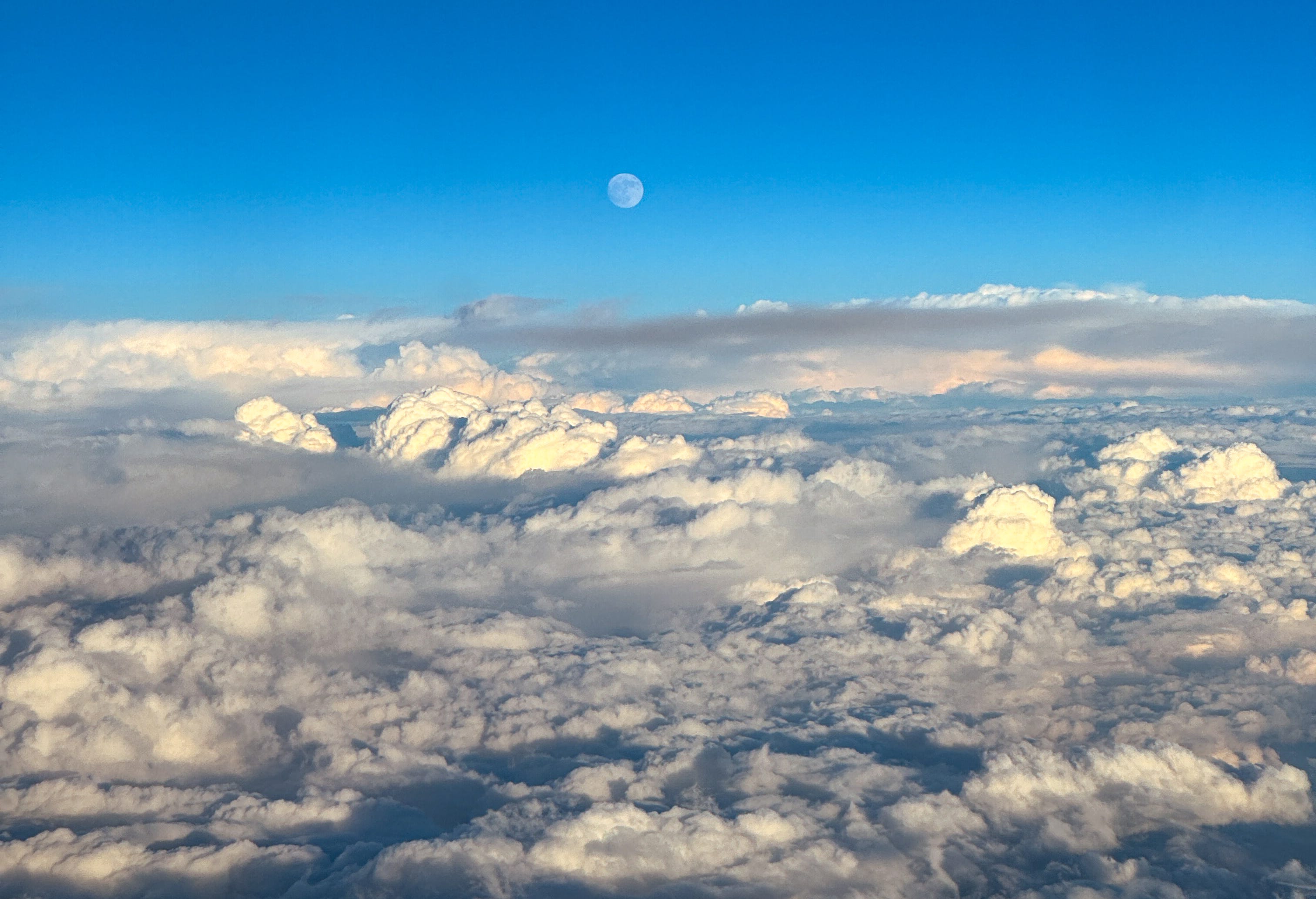
Years later, and I’ve lost the moon again. As with the first instance, I only noticed upon her brief reappearance over the little blue house one impossibly early morning. I stood still under the clearing, letting my body soak in her presence. It had been so long since we’d last seen each other. So long since I’d felt the gentle release of freneticism, the soft blinking of her dancers. So thick are the trees, so tight our valley, so dense the clouds, that the moon rarely musters the energy to break through. When she does, she releases her magic, as she always does. But the increments without her are long, and her appearances meager. I find myself envious of my avian neighbors and their ability to catch a thermal to points above these, points with unobstructed seats to her love. I catch myself thinking that maybe proximity and exposure to the moon’s grace is the secret to flight, the lightness she invites into darkness the cure for all that binds us. But then I recall that I never flew when I lived under the moon. I hadn’t needed to. Her airs were enough to turn the passive act of floating, of drifting away, into the active art of aerial acrobatics.
I realized I’d been floating here, farther away from the Equator, without the moon. Though the promise of long days breathes its warm, intoxicating breath over the summer, the energy of anxiety looms, pushing for more, more, more. There is not time for rest, nor is there time for quiet. It is the season of doing, of going, of making, of trying. The body tilts, the rhythms fall away. I watch it happen, as I float just above the ground.
I know, now, how to right myself. How to place myself gently back on the ground, exhale all that I have carried thus far, and breathe into the cool relief of simply being. I know that I need the moon, the stars, the planets, even the satellites. I need to look up into the cosmos and feel invited into its expanse, the moon beckoning my return. I need to squint at the subtle colorations marking the end of the galaxy we inhabit, to play in wonder of what lies beyond the bands it paints across the sky. I need to escape the orange glow of humans and find respite in the stillness, to watch the sky deepen into shades of indigo instead of marking the ends of days by slowly softening shades of evergreen.
I know she will return; she always does. I just hope I can find her again.
Here’s to lifting our chins, and howling at the moon.
- Megan