

Today’s accompanying tune: “Have You Ever Seen The Rain?” by Creedence Clearwater Revival
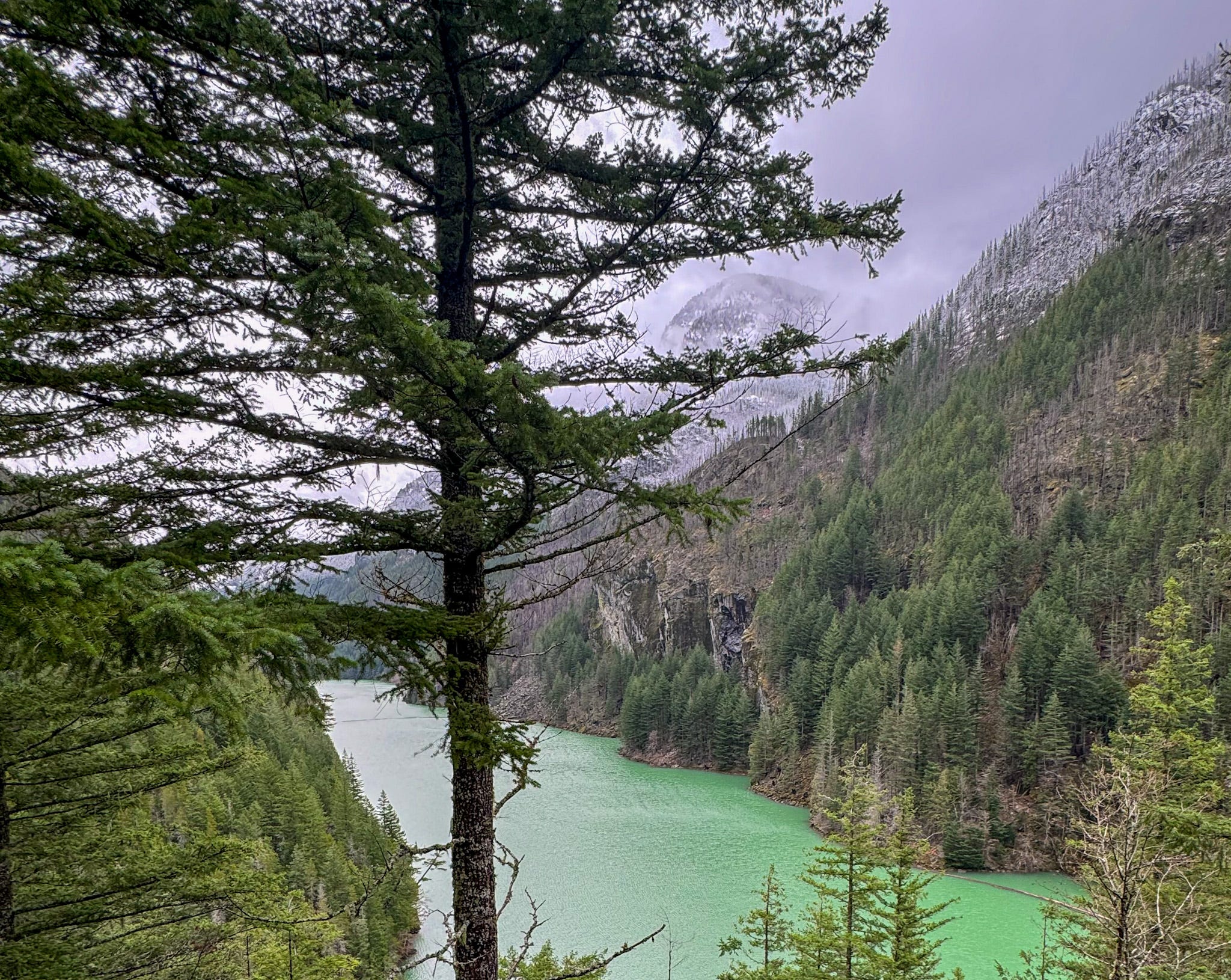
I first met the Skagit River on a dreary January afternoon. Even with the soft light of the cloud-filled sky, the gradient of the glacial river was nothing less than striking. Out west, closest to the Pacific Ocean, I could make out the faintest tint, a suggestion of the massive river’s origins if I squinted at just the right angle. As I made my way upriver, the tint concentrated, telling on itself as it roiled among the rocky bed. It was as if the water had been lit from below instead of above, the icy blue of a sports drink glowing against the lackluster sky. A group of birdwatchers had congregated on its northern shore, binoculars in hand, watching as bald eagles feasted and nested to the south. The ability to see their aquatic prey through the opaque waters yet another achievement of the birds’ renown eyesight.
Further upstream, the powerful river narrowed, carving deep canyons among the granite. The concentration of minerals present in the glacial silt increased so that the ombré went from the light, refreshing blue to the electricity of a vibrant teal. Waterfalls spilled over cliffs, the water eager to join the stead march westwards. Humans, wont as they will, dammed the river in three places in the 1920s and 1930s in an effort to provide hydro-electric power to the growing hub of Seattle to the south, an effort that continues to provide roughly 20% of all electricity in the city. Even with the disruption, however, the river continues to provide ideal spawning habitat for all five endemic salmon species and two endemic trout species. To see its headwaters, Americans will have to bring a passport, as the origin sits beyond the Canadian border. Its tributaries constitute a tangled, gnarled family tree spanning multiple countries and mountain ranges, and its only fork appears steps from the ocean. It is, on the best of days, a formidable body of water.
When the rain began, it was hard to imagine the light, soft mist turning violent as it flowed towards the ocean. At first, the forecasts seemed overblown, if not sensationalist. But two days of moderate rain became three, then four. Moderate became heavy. Smaller storms saturated the ground, leaving little give for any additional moisture. The water had nowhere to go, but down.
The steady beat of raindrops on the roof foretold of bigger moisture falling in the mountains, falling where we would never see. The mercury never sank, refusing to turn the precipitation into a useful blanket of snow whose slow melt would be both manageable and beneficial for the rivers and mountains alike. Instead, the heavy drops would fall on soil already at capacity, sliding down the mud and destabilizing root systems and boulders alike. It would crash into another, and another, and another. Streams would carry trees well beyond their rooted homes, the sturdy trunks destined to jam trestles on their way out to sea. The larger the stream, the faster it fell. The quicker it rushed towards the river, bringing all manner of debris with it.
By mid-week, the river had lost its otherworldly hue. In its place was the familiar hue of flood — the color of mud, twig, and leaf muddled together, pummeled by rock and root. The gravel bars often filled with anglers disappeared, and the water continued to rise. It reached towards the banks, towards the plant life hugging its shoulders. Soon, the parking lot where I’d previously seen the birdwatchers was submerged, as were the old growth cedars surrounding it. Water crept onto the highway, over the riverwalk, towards the high school. Into the recycling center and across the loading zone of the brewery. Neighbors filled sandbags and opened up paddocks for livestock and offered spare rooms. Those upriver were told to leave, now. We had seen enough, and trusted the forecast. The Skagit River was forecast to crest several feet higher than its record upriver and downriver. The entire valley floodplain would be submerged imminently.
The largest towns in the valley sit on the banks of the Skagit downriver, bolstered by access to the highway as well as agricultural riches. They are the hubs for nearly everything from medical care to groceries to live entertainment. Their neighborhoods sprawl out among the flat floodplains, the grid an intricate web of trestles and bridges keeping all connected. And on Wednesday night, the largest towns were told to evacuate all residents and businesses at risk of flooding. The Skagit River wouldn’t, couldn’t be stopped.
A river flood is a slow-moving, relatively predictable disaster. Officials can calculate the rate of rainfall upriver, note the rate of river rise, and look to past floods to predict who and what is most at-risk. Topographical maps can outline low-lying areas and steep slopes most at-risk for landslides. Municipalities can erect berms, dikes, and flood gates to direct water away from buildings or private property. Residents can pile sandbags in front of their homes, their businesses, their farms. Move their horses and cattle to higher ground, or house their smaller livestock with neighbors. They can pile chairs on elevated surfaces and move valuables to the highest shelf. But at the end of the day, the water will come.
The water will move as water moves — fluidly through the path of least resistance, aided by gravity. Aided by supercharged tropical storms whose precipitation refuses to fall as snow. Aided by clearcut plots completely devoid of healthy soil or heavy roots to keep erosion at bay. Aided by pavement unable to absorb water, pavement that covered over wetlands and sloughs naturally capable of diverting run-off effectively. Aided by warmer, wetter, stronger storms. Aided by a warming climate, one that seems to be best marked by water. Too much, or too little. Flood or drought. Rising tides and rushing rivers, or bare beds.
One of the common phrases I’ve seen circulating in the Anthropocene — our current era, marked profoundly by humanity’s effects on the climate — is that every person will watch the climate disaster slowly unfold on their phones, the flooding and fires and catastrophes broadcast via the internet. But eventually, it will be their turn to film. Their turn to bear witness. Eventually, they will be the ones holding the phone, documenting the disaster that hit their home, their business, their community, their forest. Their river. For all the consideration given to so-called “climate havens” — areas in which climate change’s effects are said to be lessened for the people living there — little is said about those places’ resilience in the face of a future no longer beholden to predictions, to forecasts, to trends based on historical data. Hurricanes will land in the Mojave Desert and blizzards will blanket the southern border of Texas. The lakes will rise alongside the humidity. The levees won’t hold as the river continues to rise.
It is a slow-moving, relatively predictable disaster, one of our own making. One which requires expedient, radical change and bold solutions. One that values the spawning grounds of five salmon species as much as the commercial farm downriver. One that respects the power of water — too much or too little — and acts accordingly. One that knows we cannot continue to pass the phone around, that we will all be left holding the bag eventually. We cannot outrun it, cannot strategically select a perfectly immune home. It will come for all of us eventually.
That is not, however, a reason to turn away. The unavoidability, the certainty, of the crisis has been haunting me for years. I have had moments of losing hope, of feeling like there was nothing to do and no one coming to help. And it is true that the crisis is so much bigger than one person, one household, one town. But the crisis has also taken places from me, places I’ve loved. Places I see only in the glowing back of my eyelids, places I wish to forever embalm in amber. Places now scarred black where grouse used to dance. Places underwater that used to offer mid-flight respites. Places that never deserved to be changed so drastically, so permanently, because of us. It is so much easier to fight for change — the positive kind — from a place of love. From a place of appreciation and respect. From a place that wants to watch the eagle dive into the opaque blue waters and emerge with a pink, healthy salmon. From a place that wants only to trace a river’s origins back to a glacier that refuses to shrink. From a place glowing the impossible, deep blue of ice. That is so much stronger than fear, than discontent, than indifference.
We opened these flood gates, and it is time we wrench them closed.
- Megan
Gorgeous piece that captures the Skagit's personality before and during the flood. The description of how the glacial blue shifts from a light tint near the Pacific to that vibrant teal upstream is so vivid, really made me see it. What stayed with me though is the point about climate havens being kind of a myth since eventually everybody's gonna be holding the phone documenting their own disaster. I spent a summer near a mountain town that was supposed to be 'safe' and ended up evacuating from wildfire smoke that wasn't even on anyone's radar. Fighting from love instead of fear makes way more sense than trying to outrun something that'll catch up anyway.