

Today’s accompanying tune: “Graveclothes” by Birdtalker
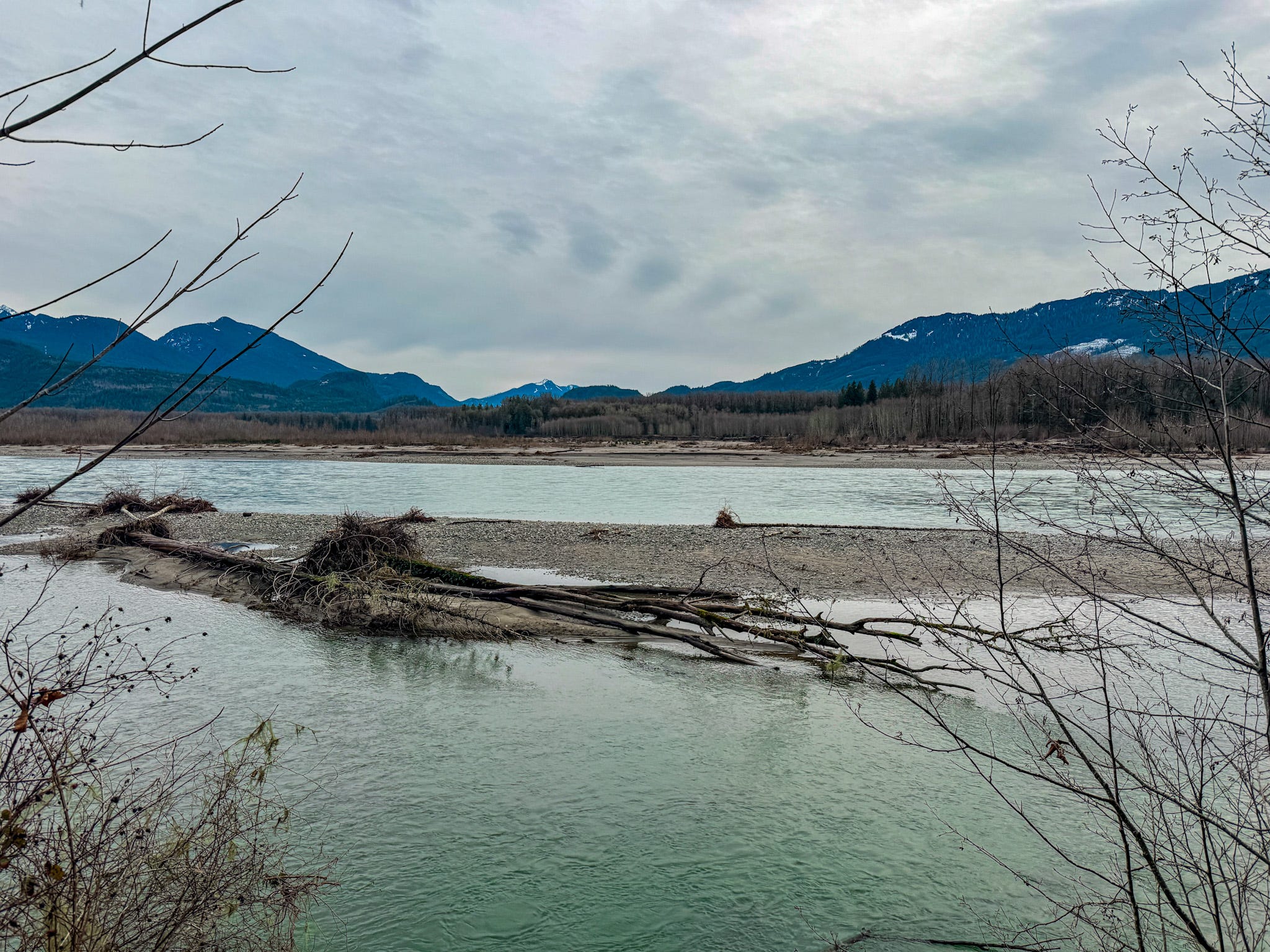
The days articulate in shades of gray. The sun rises, unseen, behind the wall of clouds, bathing the world in monotonous tones that drain the leaves, the trees, the dog of saturation. Walking through the mornings is akin to stepping back in time, planting my feet firmly in a black-and-white film though I know the colors are there, biding their time, waiting for the technology to catch up.
The pinnacle of the days’ light is lackluster, at best. The little blue house glows yellow with the help of its army of LEDs even at noon. The motion-sensor light at the edge of the driveway is triggered by the delivery vehicles that arrive well within business hours, so low is the light that it tricks the machines, circumvents our human ability to program and schedule the day based on what should be utterly predictable rhythms. Instead, it floods the intersection with light, light that would otherwise be lacking from this thing we call day.
The relief of the mountains ringing our valley are shrouded in shadow, their peaks obscured by the mass of moisture collecting well below their summits. If I squint just so, I can make out the contours of the clouds and infer the shape of the mass below. More often than not, however, the haze of rain or snow obscures it even further, hiding the details of the hulking volcanoes and their foothills under the wall of precipitation. Without the sun, it is merely another shade of gray, another gradient whose nuance I am only just learning. Two shades darker means rain, while two shades lighter means snow. Often, it falls somewhere in between.
Clear days are marked only by the rise of the clouded ceiling, so removed just enough to allow the shapes the reveal themselves though still diligently diffusing the sun’s light enough to dispel its rays. Precipitation doesn’t fall, or falls elsewhere, far enough away to become someone else’s filter, someone else’s haze. The fresh snow highlights the grandiosity of the mountains, newly revealed, the white of their blankets the only starkest contrast along the gray landscape. Starkest, save for the fields full of soft white bodies.
Each winter, our valley bathed in gray becomes a wintertime retreat for trumpeter swans, tundra swans, snow geese, and countless other Arctic waterfowl. In our low-hanging clouds and intermittent precipitation, these flocks find a balmy retreat with an ample buffet and plenty of time for socializing. They direct their young to the sloughs and farmlands of their own youths, showing the way for less informed. They nap, beak tucked under wing, as they float along the relatively stagnant waterways. They kick their webbed feet and tumble forward, feasting on the riches of healthy wetlands. Some waddle around the farmlands left stagnant for winter, the dried husks of the harvest still more appealing than wading through feet of snow further north. They honk and squawk in the tens of thousands, a chorus of gossip accumulated during a season away, a season apart. They settle in for a mild, wet winter, one full of rest and restoration, before they turn around and head north, before they take on the full days of summer in the land of a never-setting sun and abundant life.
At first, it can be hard to make out the individuals in favor of the mass of white feathers that coat the flattened lands or hover at the surface of small bodies of water. So tightly packed is the flock — a way of avoiding the related influx of predacious birds hoping for an easy meal — that individuality is all but lost, all but obscured in the gradients of white, gray, brown, cream. Birds of different species hunker down as one, the draw to fit in overriding the need for commonality. The need of the group, the same as the need for the individual. To survive the winter, they must leave, must migrate, must band together to stay safe in the wet, dreary vacation town they’ve decided to call home for as long as they must. Because as soon as the Earth tilts, as soon as the gray lifts, as soon as the sun’s rays begin to warm the soil of the farmlands they rest on, they will take to the skies, long necks extended north, towards the promise of another endless summer.
My migratory neighbors are not built to endure, at least not in a stationary way. They are meant to move, to make the most of their talents in a way that ensures their survival. They accept the offerings of the places in which they land, take the gray cloud cover over the harsh freezes and the meandering sloughs over frozen waterways. There is risk in moving, risk in flight. Risk in transit and also risk upon landing. For some, the destination is unknown. But to stay still, to remain in the north, is to all but guarantee their own demise. They have little choice — they do not have the warm coats of their land-bound peers or the ability to slow their heart rates to just above beating in order to make do with the barren offerings of winter. Their perspective, shaped by soaring over landscapes and oceans and tundra for thousands of miles before encountering an oasis rendered in grayscale. Their bodies brighten the landscape, offer a glowing reminder that this, too, is a season. It is temporary, a mark on the calendar, that will eventually turn. The gray will dissipate, the colors will return. The clouds will lift and the peaks will emerge. Though it is a season despised by many, for some it is refuge. It is a season of change, of flight, of finding the best way forward even in the face of risk, of doubt, of uncertainty.
It is a season best muddled through together, as part of a flock, regardless of how dark it may get.
Here’s to finding your flock.
- Megan