

Today’s accompanying tune: “Angels” by The xx
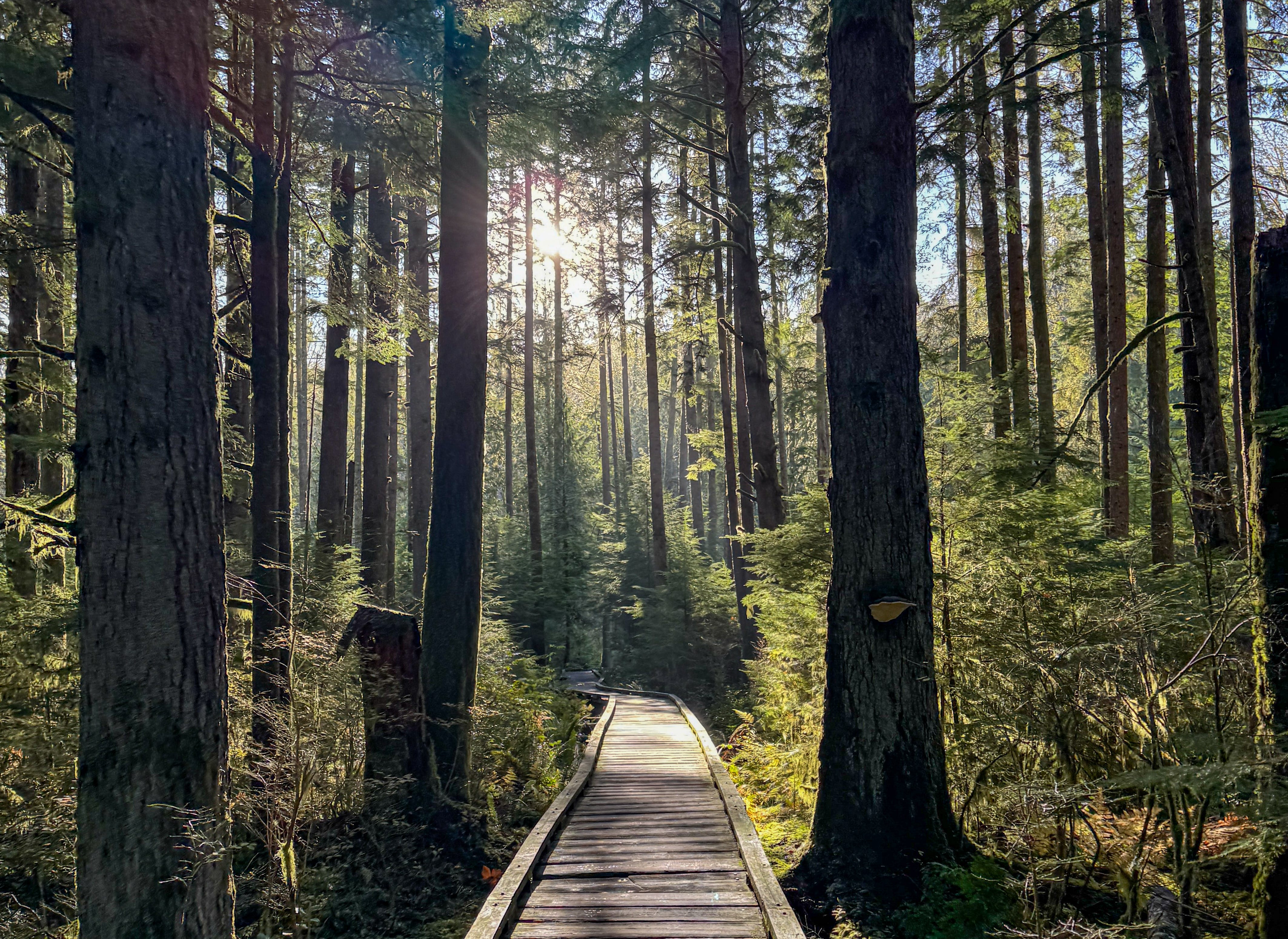
Even though I could see my breath steaming out of my mouth, the sun was climbing high. High enough that, eventually, I’d meet its rays as I wound along the trails of Grand Ridge Park. It had been a wet week, but somehow, us runners were lucky enough to enjoy a November anomaly of a dry, cold morning on race day. One that promised low winds, abundant sunshine, and temperatures only reaching the mid-50s. There are few conditions better for trail running, and I reveled in the potential of the hours ahead.
The field of racers was small, small enough that I had a chance of having an interesting race. My coach had talked me into registering for the marathon distance, though I hadn’t explicitly been training for it. We found one of the handful of trail races in Washington held in November and braced for mucky trails, limited visibility, and torrential downpours. We stuck to a reasonable goal for a race that boasted more than 4,000 feet of climbing over two laps. But as the forecast solidified, we gained confidence. I could push it, and potentially end up on the podium.
Our strategy was simple: keep up with the pack on the first lap, which ended up clocking in at over 14 miles and roughly 2,300 feet. It started with a roughly 1,000-foot climb up switchbacks over terrain the organizers called technical, but I’d categorize as pretty typical of Washington trails. A bit rooty, a few rocks, but nothing exceptional. At the top, we split right while the 5-mile race course branched off to the left. Two volunteers braved the chill to help direct, and as I looked up to smile at them and thank them for their help, my foot snagged on a rock.
“Don’t look at us!” they cautioned as I stumbled and recovered a few steps away, moving well but now painfully aware of the increasing rockiness of the trail ahead. I was still squarely in the middle of the pack, though all other runners were out of sight. I wound through hemlock and cedar, the leaves obscuring the rocky landmines below my feet. The sun poked through the canopy, bathing the forest in golden light. I remembered what I’d said the day before, that even if the race went poorly, at least I got to spend a perfect day outside in November. There was little more I could ask for, and the day was happy to deliver.
Another runner and I stuck together on the back side of the course, navigating a few poorly marked intersections and hoping for the best. We joked that we were glad we were running together, because at least we’d be lost together if we had made a wrong turn. We extended our arms as we flew down the curved path, watching our steps more than anything. The last thing either of us wanted was to fall, to be taken out of a race that was going so well by something entirely within our control.
We started seeing the runners on the shared 50-kilometer course on the way back in, their lighter bibs and easy gaits a giveaway of the longer distance ahead. They’d left just about 15 minutes ahead of us, and we started to get excited about hitting the turnaround point of the course so we could head back down the way we came. One runner in front of us tripped and fell hard into the moss-covered shoulder of the trail on a turn — I pulled off to the side to help her up and off the main trail to give her a chance to catch her breath. She cursed at the unsteady rolling rocks hidden among the leaves blanketing the ground, saying it wasn’t the first time she’d fell so far today. But she dusted herself off and continued on towards the air station at the top of the hill.
As we reached the turnaround, the half-marathoners had caught up. They’d started nearly an hour after we had departed, and the front-runners were absolutely barreling down the single-track trail. I didn’t envy them, their time on the course. How speed was paramount on the tricky, deceptively technical course, without much room for error. I was looking forward to my second lap, where I could really push myself and see what we were working with. Where I could revel in the freedom of an emptier trail and knowledge that I’d made it through the worst of it. The sun would be as high as my spirit, and the podium was still squarely in reach. I descended the trail from the turnaround point and found myself on the boardwalk, a blissfully cruise-worthy section of the trail without hazard. I soared.
The climb out of the boardwalk had been battered by the other runners, with loose rock and slippery mud down a single overgrown path. One runner barely fit, and runners going both directions were still attempting to make it through. I ascended and my heart rate spiked as I caught another rock. This time, the pain stayed, making every step even more hazardous than before. Each misstep threatened to end my run, with pain ricocheting through my foot and into my ankle. I’d tweaked my ankle months ago on a backpacking trip, compounded by little rest and a month of hiking on slippery roots. It never threatened to derail me, though if it had maybe I’d given it the attention it required. There’s no way to know, and of course hindsight is the only scenario in which my vision is near-perfect.
Around mile 10, my race had ended. I took one misstep too many, one rock just too big and too awkward for me to recover. The pain shot up my leg as fast as lightning, locking out my knee and hip and forcing me to an immediate halt. It reverberated among the small bones of my foot tucked securely in my shoe, the swelling evident nearly immediately as the upper portion of my foot pushed into the upper portion of my shoe constrained by its laces. I had at least four more miles to the main aid station where I planned to check with medical and, if things seemed mostly in tact, continue out on the second lap with some tape and wrapping. I hobbled along, testing the foot here and there when I got impatient. I could bear weight, but it felt far from good. I nodded as runner after runner passed me, congratulating them on a race well run. I thought about the daunting task of taking on another 14-mile loop, making the marathon closer to 29 miles than 26.2. I waited to see the runners go back on on their second lap, prepared to cheer for the audacity we all shared. But even as I closed the gap between myself and the aid station, few outbound runners appeared. I counted three, total, that had set out to complete the marathon, and most of the back-of-the-pack runners had also passed me by that point. We’d started the day with roughly 50 or so runners.
The volunteers rummaged through a storage bin for their medical supplies as I hobbled up to the aid station, emerging without much more than bandaids and gauze. They asked if I could use either of those, if I knew how to wrap it myself because none of them did. I considered the gauze, the mud, the rocks. The lack of other runners going back out onto the course, the line of marathoners scratching from the race with the volunteer to my left. I tested my foot again. It protested, loudly. I would not be going back out on the course.
It was my first DNF, one almost entirely within my control. I fought the tears as I hobbled back towards the finish line, back to my car. I pulled up the list of urgent care centers on my phone and weighed my options — I now had the rest of the day at my disposal, and the pain was great enough to be dealt with instead of ignored. I know my body well. I know its aches and pains, the way it groans through the first few miles before opening up and locking in. I know the way it likes to take in fuel, the way it likes to recover. Which stretches it prefers, in which order. I know how it adjusts for heat and for cold, and which of those it would rather endure. On that Saturday, I knew it wanted help. Wanted me to listen, to rest. And if I wanted it to work with me again, I knew it was time to listen. Time to rest.
After three and a half hours in the waiting room, the doctor confirmed I’d partially torn several tendons in my left foot. Some had been torn earlier, she said, and were still healing only to rupture again. Others were threatening full tears, a diagnosis that would require surgery and months of recovery. The only way to prevent the worst case scenario, she said, was several weeks in a walking boot, followed by several more weeks of physical therapy, and only then could I ease back into running.
I pulled out of the other race I’d signed up for and messaged my coach. I grumbled and felt sorry for myself, became annoyed at the inconvenience of my newly limited mobility and impending antsiness of my mind unable to calm itself with movement.
Just like the mountains, running will still be there when I can return. It was not the first time I’d been turned around in the outdoors, not the first time I’d had to make a cautious decision with limited information. I’ve turned around just below the summit numerous times for a variety of reasons, scrapped hikes before they’ve even started due to lingering illness or missing footwear.
Each time, the disappointment is heavy, and it never lightens. It carries forward into the next trip, into the next run. It lives in my pack, in my head, in my body. I feel it in the tension between my shoulders and the increased awareness of potential hazards. I try not to let it rule, lest it talk me out of reentering entirely. I ask myself what level of risk is acceptable, again and again, unsure of what the answer is or should be. I know even the most mundane trip out my front door is risky, that even a run on the treadmill carries its own kind of risk. If I wanted to avoid risk, I’d likely never lace up my boots or runners ever again. That would be the safest way forward.
But it is not the life I want. I want to try hard, to do audacious things, to put it all on the line from time to time. I want to feel the freedom of extending my arms while cruising down a twisty trail on a perfect November morning. I want to realize the potential of an audacious life, one full of stories complete with peaks and troughs. And as I navigate this trough, I think more of what lies on the other side than where I’m currently at. If we’re climbing from all the way down here, that view must be worth it.
Here’s to taking a chance, even if it doesn’t work out.
- Megan
Sorry to hear about the injury! Good luck with PT and recovery.