

Today’s accompanying tune: “The Levee’s Gonna Break” by Bob Dylan
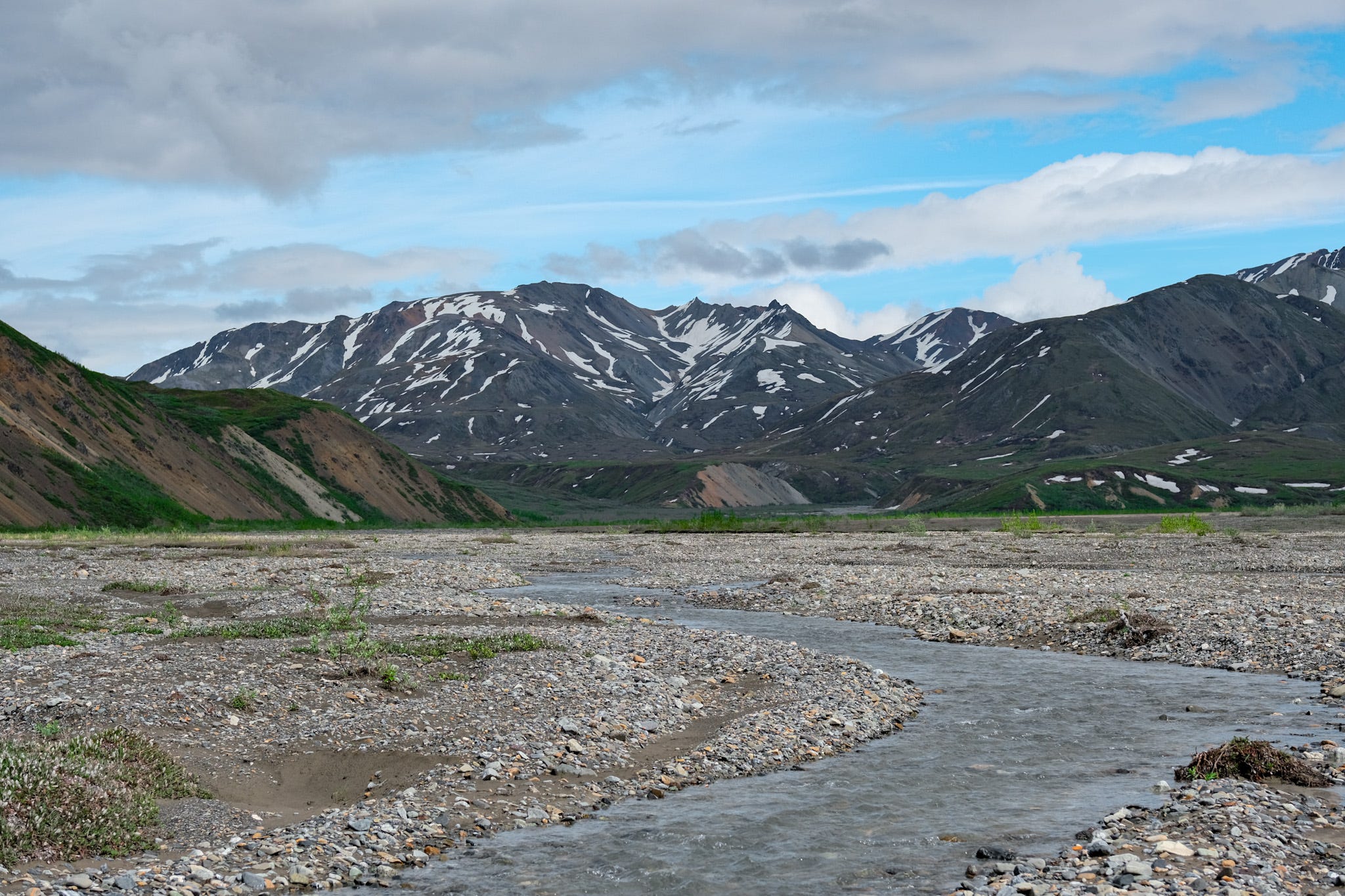
It didn’t seem like much. The murky, dusky water was slow, churning along the gravel bars that rose just enough before its crest as to remain dry. The bank didn’t drop so much as dip, the distinction between river and earth a matter of centimeters instead of feet. Its arms meandered through the rocky bed, braiding its way across the tundra without a discernible goal, with few arms wider than could be hopped across. Its shallowest trickles clear over the tumbled stones that had been carried along; its opaque strands obscuring whatever sank beneath.
Our group had to cross the Thorofare River in Denali National Park in order to climb the ridge just behind, our only true objective for the day. We’d hopped and skipped our way over numerous smaller streams and creeks, carefully balancing on the loose gravel before landing on the far side without much fanfare. Eventually, we made our way to the largest channel we’d have to cross — the dark, glacier gray water covered roughly 30 feet between us and the far bank. We waded out, poles in hand, as we sank deeper and deeper into the chilled river. We lifted our feet with effort — the sediment in the water swirled so thickly we couldn’t make out where we were landing, and would softly shuffle among the muck to avoid being thrown off balance by the current. We dragged our bodies against the water, fighting for inches and rooting solidly in the slick muck, until we emerged — wet, cold, exhausted — on the other side.
The group was relatively small; a handful of us had opted for an effortful day in hopes of staving off the insomnia that came with nearly 23 hours of constant sunlight in mid-June in interior Alaska. There was the Sierra Club couple from the Bay Area. The recent retirees eager to see the states they hadn’t yet made it to. The mother and daughter pair as likely to beat the rest of us up any hill as to be jogging to catch up, having been engrossed in picking apart scat further down the trail. The daughter was around my age, and she gladly showed me the difference between elk and moose scat when I asked. Together, we scanned the flats for signs of life, hoping to will into existence the appearance of wolves or brown bears. As we sat on the gravel bar rolling up our pant legs in anticipation of crossing the thigh-deep river, she looked at me and asked if I’d had any luck making friends after college.
Outside of a handful of folks, I hadn’t, I told her. I’d met a few people through the various jobs I’d held, some of whom outlasted our places of work. Many had naturally fallen off when we moved, and even more dropped away when we moved again. Others had accommodated major changes in their own lives — kids, marriage, grad school, new careers, new relationships — and had less room for the kinds of friendships we’d previously had. Adulthood had descended on us, I said, and a lot of people reacted to it by turning inward in an attempt to survive it. I joked that making friends — and keeping them — was probably a lot like crossing the river we were both eyeing. We couldn’t see what we were getting ourselves into. We knew it would take more effort than anything we’d done so far that day. But we didn’t know what the view was like on the opposite bank, just that we wanted to know enough that we were willing to try.
We exchanged numbers at the end of that trip, intent on making an effort to stay in touch. We made rough plans for a backpacking trip in the Eastern Sierra later that summer, the logistics to come later. But as often happens, life got in the way. Adulthood descended on us as soon as we stepped foot off the tundra and onto the tarmac.
It has only been two and a half years since I crossed the Thorofare — twice — but its muck has been clinging to my mind. For so long, navigating relationships have felt like wading into the glacial melt, my unsure, shuffling steps designed to keep me upright while I made minimal progress with maximal effort. I could only rarely see the bank on the other side, unsure of where I was headed, unsure of what I was seeking. But still, I was curious enough to find out. Sometimes, I wonder if it was less curiosity, and more desperation.
To win acceptance and likability, I was happy to become anyone, to be anything, in my young adult years. I happily tagged along for others’ events, restaurants, concerts, and hobbies. I listened to gossip about people I’d never meet and gave bits of advice about siblings or parents that were little more than fiction characters in my mind. I went to gyms I’d never set foot in on my own; I attended brunch. It was fulfilling, being someone reliable, someone who was always there, someone who would always say yes to any invitation. I thought, for many years, that my unyielding commitment to others was a yardstick against which one could measure my ability to be a good friend. At the same time, I lamented in the lack of reciprocity that kept appearing in my relationships. I argued with myself, telling myself this was how relationships were, that some people were destined to be perpetual supporting characters to the more interesting, more outgoing people in their lives. That I was lucky, even. Lucky that these people were willing to tolerate my presence. Lucky that they wanted me around. Lucky, but so lonely.
The loneliness, though, was a gift recognized best in hindsight. Moving to the Mojave Desert, where I knew only a handful of people, meant I could shrug off the performance of friendship and begin to understand my own definition of it. I learned how to be present without being able to be physically so. I learned how to listen, how to carve out time for important moments or conversations. I became a better texter, more reliable, less flighty. Even as my social circle contracted, my inner life soared. Without the pretext of performance, the struggle faded. I had shaken off the muck, the sediment, that I had been wading through up until that point. I stopped forcing my way across the current, had stopped shuffling my way across the slick river bottom. I became the friend I had wanted; the person I could depend on most was now the one with whom I shared a body, a brain. I tried my hand at honesty with those around me, people that I felt certain were too cool, too interesting, too funny, too inspiring to consider me a friend. I had abandoned the idea that I would be accepted by them, these incredible people of the desert, and in the absence of that pressure, I became myself. And, as it turned out, those people were far more inclined to like and accept me, as I was, than anyone else had been.
In letting go, I had opted to let the current carry me to myself. And on the shores of myself, I found the confidence, the care, and the empathy I needed to move forward.
The Thorofare is called such because of the constant stream of wildlife that moves alongside its braids. It is the highway of the fauna world, a place to gather, eat, exchange gossip and useful information, a place to scout for mates, a place to teach young. It is, essentially, a town hall. A community center. A watering hole. It is not without danger, this gathering of wildlife. When predators move in, the rest of the community darts out. They keep watch for one another, moving fast without losing sight of the risk they all face. It is not an action they calculate, looking out for one another. It is not one they weigh, deciding whether the inconvenience is worth the effort. It is a relationship they honor at the most basic level, a handshake agreement with the other living beings around them with irreversible stakes. One full of confidence, care, and empathy. Survival, for many, depends on the whole of the herd.
Community, then, is one of nature’s oldest, most enduring tenants. It is not served by those with their own interests at stake, those that move through the world without care for others, those that see life as a zero-sum game which they must win. Various species of trees have been documented working together to ensure the survival of a forest, so well do they know that a homogenous ecosystem is one prone to disease, to fire, to disaster. The animals of the tundra watch each other for warnings, those on long, lean legs the first sign of an approaching predator for those lower and slower. Each, a role to play, in their individual ways. A villager. A community member. A part of the herd.
To be in a relationship with another human — friends, family, partners, children, neighbors, acquaintances, book club members, the barista with whom you share gentle morning banter — is to partake in one of nature’s deepest, oldest rituals. To take on the care of another as if it were your own simply because it is the right thing to do, the right way to be, in this world. It is only possible when we become ourselves, the people with humor and determination and interest and inspiration. That journey is reflective of who we surround ourselves with, yes, but it is just as reflective as our relationship with ourselves, our own sense of value, our own sense of worth. To emerge on the other side of the bank, we have to put in the work to shuffle through the muck, the rocks, the deep sinking mud. On the other side is not the relationship we had hoped, maybe, but the one we needed to move forward. The one with ourselves.
To live, then, is to take that relationship and use to propel our communities, our friends, our people. To stand up for neighbors regardless of the language they speak or their country of origin. To place ourselves between the most vulnerable and those looking to harm them. To recognize that a risk to one is a risk to all, and that our best defense is in each other. It is not enough to play a supporting character in another’s life; our lives are fullest, at their most human, when intertwined.
Here’s to pulling our bodies through the muck, to the other side, and out into the sun, together.
- Megan